Colombian ‘military plan for FARC’
Latest US cable revealed by WikiLeaks say former Colombian president mulled sending troops to capture Venezuelan rebels.
 |
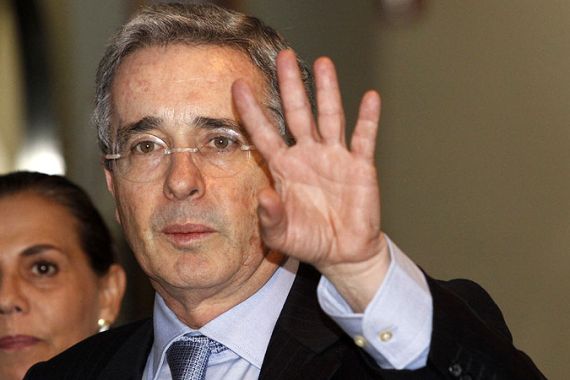
| Leaked US embassy documents said Alravo Uribe had considered sending in troops to capture Venezuelan rebels [EPA] |
Alvaro Uribe, the former Colombian president, had plans to order troops into neighbouring Venezuela to capture rebel leaders in 2008, says the latest secret United States document unearthed by WikiLeaks.
According to another leaked cable, Uribe had suggested to a group of visiting US legislators that Hugo Chavez, the Venezuelan president, was a threat to South America similar to the one Adolf Hitler once posed to Europe.
Uribe said in the document from the US embassy in Bogota dated January 28, 2008, that he believed the “the best counter to Chavez … remains action, including use of the military”.
He said in the report published on Friday by the Spanish newspaper El Pais “he was prepared to authorise Colombian forces to cross into Venezuela, arrest FARC [Revolutionary Armed Forces of Colombia] leaders, and bring them to justice in Colombia”.
Chavez broke off diplomatic ties briefly with Colombia in July after Uribe accused him of harbouring leftist rebels, allegations Chavez has long denied.
The Colombian leader ended his presidency in August amid bitterness and hostility with Chavez.
The leaked cable said Uribe discussed the idea of a military operation in a meeting with US Admiral Mike Mullen, the chairman of the Joint Chiefs of Staff. It was not clear how Mullen had responded.
Colombian action
Less than two months after the meeting, Colombia’s military attacked a FARC camp in Ecuador on March 1, 2008, killing Raul Reyes, one of the rebel group’s senior leaders.
The raid near the Colombian border sparked a diplomatic spat with Venezuela and Ecuador, which Uribe defused soon after by apologising and pledging not to repeat such an action.
A year later, Chavez froze diplomatic ties with Uribe’s government after Colombian officials said that Venezuelan weapons had ended up in the hands of FARC rebels. The Venezuelan leader also objected to a deal for Colombia to allow an expanded US military presence at its military bases.
Chavez and Juan Manuel Santos, Uribe’s successor, have since smoothed over the disputes and pledged to restore trade badly hurt by the diplomatic impasse.
Uribe had previously authorised a covert operation to capture a FARC leader in Venezuela.
In December 2004, undercover Colombian agents captured Rodrigo Granda and brought him back to Colombia, an effort that unleashed the first of multiple diplomatic crises with Chavez’s government.
Granda was later freed from a Colombian prison in 2007 as part of the Colombian government’s efforts to secure the release of hostages held by the FARC.
‘Hitler-like threat’
Another US embassy cable dated December 6, 2007, said that Uribe “likened the threat Chavez poses to Latin America to that posed by Hitler in Europe”.
It also said Uribe believed Chavez “was trying to create a ‘personal empire’, and had expansionist plans in the region for his model of ‘new socialism'”.
According to an earlier document dated 4 August 2005 Uribe was candid in describing Chavez as “a mix of someone with imperial sentiments and drunk with socialism”.
Uribe said Chavez has dreams of an hemispheric television station and a unified oil company, and was looking to create a new coalition to confront the US.
Uribe said he was resigned to the fact that political unrest was probably inevitable, given Chavez’s efforts to create a “new socialism”, his total domination over Venezuelan institutions, the lack of opposition and checks and balances, and the prospects of hyper-inflation.
Al Jazeera is not responsible for content on external links.