US permits war dead coverage
Following policy review, US media covers return of body of airman killed in Afghanistan.
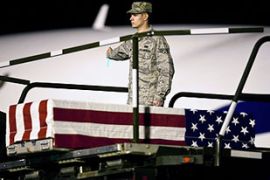
However, critics said the move hid the cost of war from Americans and Barack Obama, the current US president, asked the US department of defence to review the decision.
Robert Gates, the defence secretary, said he was uncomfortable with the ban.
Legal challenges
The family of Myers, who died on April 4 near Helmand province in Afghanistan after being hit with an improvised explosive device, was present at the air base when his casket was unloaded from a cargo aircraft.
They declined to be interviewed or photographed, as dozens of news photographers and camera crews took pictures and broadcast images of his body’s return.
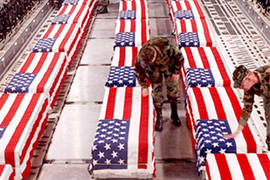 |
| The issue of war dead media coverage has proved highly controversial [EPA] |
Under the new policy, families of fallen servicemen will decide whether to allow media coverage of their return.
If several bodies arrive on the same flight, news coverage will be allowed only for those whose families have given permission.
There have been some exceptions to the ban since 1991, most notably in 1996 when Bill Clinton, then US president, attended the arrival of the remains of Ron Brown, the US commerce secretary, and 32 others killed in an air crash in Croatia.
In 2000, the Pentagon also distributed photographs of the arrival of remains of those killed in the bombing of the USS Cole in Yemen, and in 2001 the air force distributed a photograph of the remains of a victim of the September 11 attack on the Pentagon building.
There have also been several legal challenges to the policy, with the Pentagon in 2005 releasing hundreds of military images of flag-draped coffins of soldiers killed in Afghanistan and Iraq following a “freedom of information” request and lawsuit.