Groups urge end to Guantanamo
Human rights protests hit out against the US military camp on its fifth anniversary.

Irene Khan, Amnesty International’s secretary-general, said: “No individual can be placed outside the protection of the rule of law, and no government can hold itself above the rule of law.
“The US government must end this travesty of justice.”
Five years
The first detainees flown to Guantanamo five years ago were captured in the US-led war on Afghanistan following the September 11, 2001, attacks on the US.
|
“We’re keeping enemies of our nation, enemy combatants, or terrorists if you will, off the battlefield” Harry Harris, |
Harry Harris, a navy commander of the detention centre, said: “What we are doing is an important and integral part of the global war on terror.”
“We’re keeping enemies of our nation, enemy combatants, or terrorists if you will, off the battlefield.
“We don’t do anything today that’s coercive in nature. I believe we are doing things correctly here.”
The detention camp itself has undergone a transformation since the early days when prisoners were kept in metal open-air cages and used buckets for toilets.
Jumana Musa, Amnesty’s advocacy director for international justice, told Al Jazeera: “People ask, have conditions improved since it was opened five years ago? Absolutely.
“But one of the things that is a lot less tangible and harder to understand is not the physical abuses, but the mental pressure, the mental stress and the psychological strain of indefinite arbitrary detention.”
James Carafarno, Heritage Foundation expert on military affairs, however, denied this interpretation.
| Your Views |
“It’s not arbitrary, and it’s not intended to be indefinite.
“There is an annual review process, and when a person is determined to be no longer a threat to the US, and a place can be found for them where they won’t be tortured, that person is released.”
Habeas corpus
Since 2001, more than 770 captives have been held there and of those 10 have been charged with crimes, sparking criticism by foreign governments and rights groups. About 395 suspects remain in the camp in southeast Cuba.
Colonel Morris Davis, the chief prosecutor, said that the US military plans to charge 60 to 80 of the detainees, and expects military trials to start next summer.
“It certainly looks like we’re much closer to getting these guys their day in court,” he said.
Most of the remaining detainees, however, may never be tried by a military court.
In 2004, the US supreme court ruled that detainees could go to American courts to seek their release or changes in confinement conditions.
However, the military commissions act, signed by George Bush, the US president, in October, deprives them of the right to contest their imprisonment in a civilian court, known as habeas corpus.
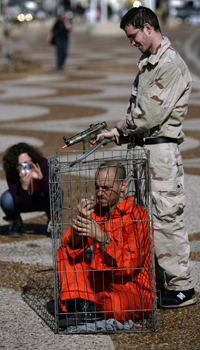 |
| An Israeli activist [AFP] |
Katherine Newell Bierman, a Human Rights Watch counter-terrorism counsel, said military hearings that allow prisoners to challenge their detention before a neutral decision-maker are inadequate.
“Without habeas corpus proceedings, there is no check on the executive power or decisions just to lock people up indefinitely.”
Moral authority
Chito Peppler, a Pentagon spokesman said: “There is no requirement under the law of war … that a detaining power charge enemy combatants with crimes, or give them lawyers or access to the courts in order to challenge their detention.
“The information gathered from detainees at Guantanamo has undoubtedly saved the lives of US and coalition forces in the field. That information has also thwarted threats posed to innocent civilians at home and abroad.”
Amnesty said the US operation at Guantanamo Bay has weakened human rights and the rule of law and undermined Washington‘s moral authority to speak on other human rights issues such as the fighting in Darfur, Sudan, which Washington has described as a genocide.
Adil al-Zamil, sent home from Guantanamo in November 2005 and cleared by a court in Kuwait of all terrorism charges, said that detainees are “living in hell”.
“I pray to God to give them patience,” he said. “If I was still there, I’d be a crazy person.”