China denies knowledge of Libya arms talks
Government seeks to distance itself from reported offer by firms to sell $200m worth arms to Gaddafi’s forces in July.
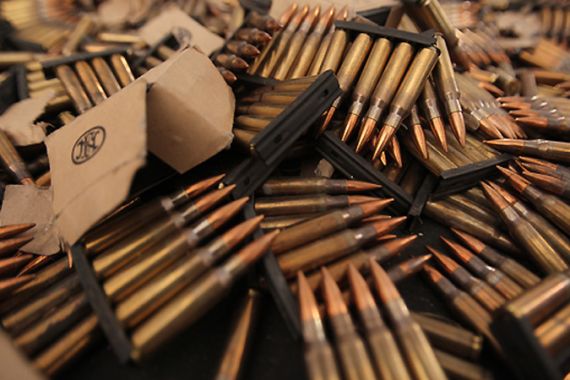
Chinese companies held talks with representatives of Muammar Gaddafi’s forces in July over weapons sales, but behind the government’s back, the Chinese foreign ministry has said.
The ministry confirmed on Monday reports in two newspapers, the Globe and Mail and the New York Times, that documents found in the Libyan capital, Tripoli, indicated that Chinese companies offered to sell rocket launchers, anti-tank missiles and other arms totalling $200m to Gaddafi’s forces, despite a UN ban on such sales.
“We have clarified with the relevant agencies that in July the Gaddafi government sent personnel to China without the knowledge of the Chinese government and they engaged in contact with a handful of people from the companies concerned,” Jiang Yu, a ministry spokesman, said in Beijing.
“The Chinese companies did not sign arms-trade contacts, nor did they export military items to Libya,” she said. “I believe that the agencies in charge of the arms trade will certainly treat this seriously.”
Commenting on the controversy, Willem van Kemenade, a China analyst, told Al Jazeera: “The Chinese denial has plausibility in the sense that the Chinese government, particularly the foreign ministry, has no control over a lot of the large influential state companies, including arms dealers.
“That China has seriously contemplated supplying arms at that late stage in the Libyan conflict, I find very doubtful, because the Chinese have been making overtures to the rebels from June.”
‘Hard evidence’ claimed
Even if the arms talks were behind the Chinese government’s back, the controversy could intensify mistrust between the country and the Libyan National Transitional Council (NTC).
“We have hard evidence of deals going on between China and Gaddafi, and we have all the documents to prove it,” Abdulrahman Busin, a NTC military spokesman, told the Times.
The arms issue comes on the heels of tensions between China and the Libyan fighters over frozen funds.
On the weekend, the head of the NTC, Mustafa Abdel Jalil, said China had obstructed the release of some of Libya’s frozen assets.
Although China agreed with other powers last week to unfreeze $15bn of Libyan assets abroad, it opposed handing control of more to the interim ruling council, according to Shamsiddin Abdulmolah, a spokesman for the Libyan fighters.
Jiang, the Chinese spokeswoman, said: “In principle, we don’t have a problem” with unfreezing funds.
“But out of a responsible attitude, we and some members of the Security Council want further explanation and information from the applicant countries about the uses of the funds and oversight of them”.
Rewards promised
Libya’s interim council has promised rewards for those who took a leading role in backing the revolt against Gaddafi, and that has raised concerns that China could be disadvantaged.
China is the world’s second-biggest oil consumer and last year obtained three per cent of its imported crude from Libya.
Although China did not use its Security Council veto power in March to block a resolution that authorised the NATO bombing campaign against Gaddafi’s forces, it condemned the expanding raids and repeatedly urged compromise between his government and the rebels.
It has also not joined Western powers in formally recognising the NTC as the legitimate authority in Libya, but has acknowledged its “important role” after Gaddafi’s toppling.
“Some of the rebel leaders have been issuing warnings,” Van kemenade, the China analyst, told Al Jazeera, “that countries like Russia and China who have not been supporting the coalition from the very beginning, might be penalised by exclusion from the reconstruction programme.”