Guinea holds first free election
Presidential poll ends peacefully with observers reporting high voter turnout.
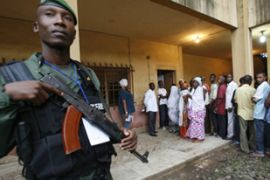
Our correspondent described the prevailing sentiment throughout the country as one of “massive enthusiasm”.
Almost 4000 local and foreign observers were deployed for the election in a country with a population of 10 million.
Vigorous campaign
Campaigning has been vigorous, with posters plastered on walls and candidates holding boisterous rallies in the streets.
“A compressed timetable for the elections has generated some irregularities and some technical challenges,” Human Rights Watch said in a statement on Friday.
“But the defence ministry’s promise to keep the military in barracks during the election period, and to back whoever wins is a very positive sign.”
| IN DEPTH |
|
|
|
|


The top contenders are thought to be Cellou Dalein Diallo and Sidya Toure, two former prime ministers and Alpha Conde, a longtime government opponent, but with 24 candidates in the running, Sunday’s vote is unlikely to produce a clear winner.
Results are expected by Wednesday, after which the front runners are expected to form alliances in a bid to win voters for a July 18 run-off.
More than 4.2 million Guineans have registered to vote, including more than 112,000 in 17 foreign countries in Africa, Europe and the US.
Guinea gained independence from France in 1958 and has since been ruled by a succession of civilian and military dictators.
It is a country “rich in minerals yet riddled with poverty”, Al Jazeera’s Simmons said.
It is the world’s top bauxite producer, a mineral needed to produce aluminum, and also holds significant deposits of diamonds, gold and iron ore.
Stadium carnage
A military government led by Moussa ‘Dadis’ Camara gained international notoriety in September 2009 after army units opened fire on pro-democracy demonstrators gathered in a Conakry stadium.
Security forces massacred more than 150 people, wounded 1,000 others and raped some 100 women.
That carnage acted as a turning point in the country’s turbulent history.
“It is remarkable to that think that only nine months ago, the Guinean army slaughtered many opposition supporters and raped women in a football stadium,” our correspondent said of Sunday’s polls.
In December 2009, Camara was shot by an aide. He survived but was forced into exile as part of a tenuous peace deal.
General Sekouba Konate, Camara’s deputy, appointed a civilian prime minister and established a civilian-led transitional governing council, paving the way for a new constitution and Sunday’s elections.