Sudan vote begins despite boycott
Country’s first multiparty polls in 24 years gets under way amid accusations of fraud.

| special report |
 |
Al Jazeera’s Mohammed Adow, reporting from the capital, Khartoum, said logistical delays also interfered with the first few hours of voting in some areas outside Khartoum.
“We’re hearing that there have been mix-ups of ballot boxes and ballot papers,” he said.
“Also here in Khartoum, there have been some setbacks with some of the polling stations opening late because of delays [in the delivery] of ballot papers.”
Opposition boycott
| In video |
|
Hoda Abdel-Hamid reports from |
In addition to the delays, our correspondent said voter turn-out has been low partly because voters may be disillusioned and unsure of who to cast their ballots for.
“President Bashir’s party is urging his supporters to come out in their numbers and vote for him,” he said.
“On the other hand, the opposition supporters whose candidates have withdrawn from the elections have been telling us that they will drop blank ballot papers in the ballot boxes to show their anger with the whole electoral process.”
Al-Bashir is almost certain of victory in the presidential race after opposition candidates pulled out, alleging widespread bias against them in the electoral system.
Yasir Arman, a northern Muslim representing the former southern rebel Sudan People’s Liberation Movement(SPLM), and Sadiq al-Mahdi of the Umma Party,have both withdrawn from the race.
They accuse al-Bashir of fraud and say free and fair conditions for the elections are not in place, particularly in Darfur, the western region under a state of emergency since civil war broke out seven years ago.
Anti-government groups in Darfur, who control parts of the vast western region, firmly rejected the elections but have so far not stated any intentions to derail the process.
Credibility ‘undermined’
While the result of the presidential poll holds little suspense, elections for parliamentary and local representatives are still fiercely competitive in many parts of the country.
Activists cautioned on Saturday that the credibility of the election had been undermined by the allegations, which they said have been ignored by al-Bashir’s ruling National Congress Party(NCP).
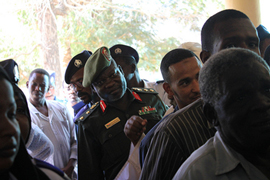 |
| The elections are seen as a step towards the south’s referendum [Fatma Naib/Al Jazeera] |
“Violations of human rights – particularly restrictions on freedom of assembly and freedom of the press – are threatening prospects for a free, fair and credible vote across Sudan,” Georgette Gagnon, Africa director of Human Rights Watch, said.
“Sudanese authorities are clearly failing to uphold international standards.”
The criticism comes as hopes dim that the elections will be a watershed moment as Sudan attempts to put decades of conflict behind it.
Southern Sudanese are also voting to elect a leader of the semi-autonomous government of the south.
But last-minute boycotts have revealed the fragility of the 2005 peace dealthat ended the country’s long North-South civil war.
The NCP has ruled Sudan in a coalition with the SPLM since the signing of the peace agreement.
Part of that deal was an agreement that Southern Sudan could hold a referendum on independence and many in the south see these elections as a step towards that goal.