UN aid to reach DR Congo refugees
Convoy aimed at helping 50,000 people who fled camps around the city of Goma.
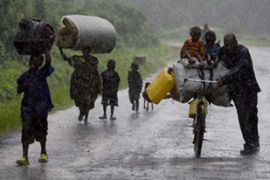
The aid convoy was given the go ahead after government troops and fighters from the National Congress for the Defence of the People (CNDP) promised to allow it safe passage from the provincial capital of Goma.
Safe havens
The region has seen a mass movement of people in recent days as they have tried to find a safe haven from an offensive by the CNDP, led by Laurent Nkunda, a renegade general who says he is fighting to protect the region’s ethnic Tutsis.
| Your Views |
|
How should the UN respond to the escalating violence in Democratic Republic of Congo? |
Many people who fled their villages due to the fighting in North Kivu province found themselves in makeshift camps around Goma, but these then emptied as the government forces crumbled in the face of the CNDP advance.
“Most of these people fled the camps in fear and in panic as they heard that troops were advancing on the area,” Fernandez said. “There was considerable panic in the area.”
Al Jazeera’s Mohammed Adow, reporting from Kigali, the capital of neighbouring Rwanda, said aid workers had decribed the humanitarian situation as “catastrophic”.
“They are accusing the rebels of forcing people out [of the camps]. People are scared to return home and are heading into the bushes. Relief agencies say these people have no food, water or shelter.”
Humanitarian corridors
Nkunda has announced the opening of “humanitarian corridors” through rebel lines, as a ceasefire he declared on Wednesday appeared to be holding.
The main road linking Goma and Rutshuru, 75km to the north, was again packed with people on Sunday as some of the displaced people tried to return to their villages.
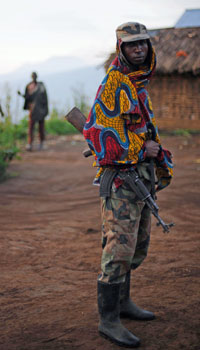 |
| Nkunda says his fighters are protecting ethnic Tutsis [AFP] |
“We received no food, so we are returning,” Paul Bashoboye Bareke, walking with his wife and their eight children, said.
European and US envoys travelled across the region over the weekend in an attempt to find a diplomatic resolution to the crisis.
David Miliband, the British foreign minister, and his French counterpart Bernard Kouchner met Jakaya Kikwete, the Tanzanian president and chairman of the African Union, on Sunday following talks with Joseph Kabila, the DR Congo president, and Paul Kagame, the Rwandan leader.
Kabila and Kagame have agreed to attend a summit in Nairobi, Kenya, next week to discuss the conflict, which Kinshasa accuses Kigali of supporting by aiding Nkunda’s forces.
Rwanda denies any involvement in the fighting, but the Uruguayan military commander who oversees his country’s deployment in DR Congo has suggested that Nkunda has Rwandan tanks and artillery.
Oxfam, a UK-based aid group has urged the European Union to provide troops to support the 17,000 UN peacekeepers who are stretched across the vast country.
“The European Union is well placed to rapidly provide the additional troops that the people of Congo desperately need,” it said in a statement.
However, Kouchner and Miliband stopped short of suggesting that European countries would provide soldiers on the ground, while EU leaders continued to empahsise the need for a political solution.