News
In Depth
Programmes
Video
Blogs
Business
Weather
Sport
Watch Live
Africa
Americas
Asia-Pacific
Central & South Asia
Europe
Middle East
Focus
Opinion
Features
In Pictures
Interactive
Spotlight
Briefings
Your Views
Inside Story
Witness
Listening Post
People & Power
101 East
The Stream
More
Counting the Cost
News
Africa
South Sudan steps up to self-rule
Despite government corruption the people of south Sudan relish their renewed freedom.
Mohamed Vall in Juba
Last Modified:
05 Nov 2007 15:21 GMT
Email Article
Print Article
Share Article
Send Feedback
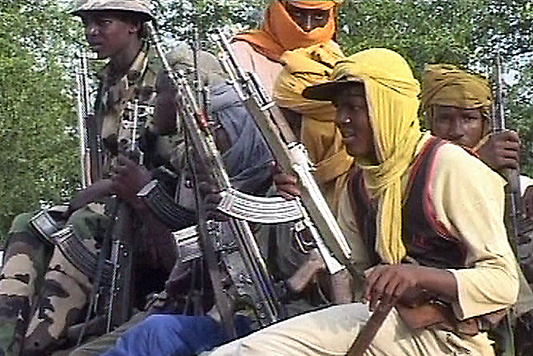
The Sudanese People's Liberation Movement are accused of failing to develop the south [AP]
Despite a peace deal being established in 2005, many people in the south of Sudan are frustrated at the slow pace of change after a 21-year civil war.
Instead there is a growing awareness that any future lies away from Sudan and close to their African neighbours.
Al Jazeera's Mohamed Vall has been to southern Sudan to assess progress there.
There are currently 10,000 UN peacekeepers in southern Sudan to enforce the Comprehensive Peace Agreement signed between the government in the north and the Sudanese People's Liberation Movement (SPLM) in the south.
As part of the deal the south has been given six years to move to self-government, after which they are required to hold a referendum to decide whether to secede from Sudan.
One benefit of the peace deal is that the profits from the fought-over oilfields of Sudan are to be shared between the north and south.
However, plans for the the referendum do not appear to be on track and SPLM leaders have recently accused Khartoum's authorities of falling behind on their commitments.
Southern government difficulties
In Juba, the capital of southern Sudan, many say the peace dividend is not being cashed in.
After so many years of warfare, the city is still largely underdeveloped and accusations of local government corruption of and violations to the peace deal abound
Here there is an increasing movement away from Khartoum and towards its African neighbours or Western thinking.
Schools there have changed their curriculum, replacing Arabic language classes with English.
Beyond the school gates there are hopes that the 'cultural divorce' from the Arab north will also have an economic benefit to it.
In terms of distance, Juba is 15 times closer to Uganda than to Khartoum and in its market every single commodity is imported from near neighbours Tanzania or Uganda.
In additionally, nearly all the merchants and business owners in the city are foreigners.
A baker and a stone merchant are the only Sudanese success stories.
The bread is produced locally and the stone merchants employs a large population.
They eke out a living by chiselling little stones from the mountain rock and selling them by the kilo for use in floor paving and house construction.
Poverty, unemployment and lack of infrastructure are all prevailant here.
Happy to be free
Yet, for all the hardships southerners say they are happy; they are surviving more on the glories of the historical peace agreement with the north rather than on any material gains from it as yet.
One Juba resident said: "We are enjoying peace, there is a little bit of freedom."
"I am happy because I am now in my motherland, my heart is at rest," another said.
The few reconstruction projects currently under way in Juba are giving a morale boost to a young population that is already euphoric about the new self-rule in southern Sudan
As a young Juba resident says:"Although I do not get my pay currently, I am expecting good pay in the future.
"We progress slowly, slowly. Rome was not built in a day."
People like him acknowledge the setbacks of their government however; as another resident says: "Corruption is there, corruption is causing a lot of problems. It is bringing underdevelopment to the state."
Yet, while corruption and failing policies are all subject for compromise in the south the experience of self-rule is not, and the overwhelming majority of southerners are intent on full separation from sudan as soon as they are allowed it.
Source:
Al Jazeera
Email Article
Print Article
Share Article
Send Feedback
Topics in this article
Country
Sudan
Featured on Al Jazeera
Working Man's Death
An unflinching portrait of physical labour in the 21st century.
Imperialism, despotism, and democracy in Syria
The stark choice between a fascist or an imperialist course in Syria should be discarded for a third and better course.
Words matter: A new language for peace
Israel's propaganda machine carefully chooses its words to assert illegal ownership over Jerusalem and Palestine.
Will Israel attack Iran?
As Western fears grow over Iran's continuing nuclear programme, we ask how a military strike could impact the region.
Top News Accordion
Top News
Greek parliament approves austerity bill
Arab bloc to request Syria peacekeeping force
Malaysia deports Saudi in Twitter posts row
Venezuela votes in opposition primary
Peru's Shining Path leader 'captured alive'
News
Africa
DR Congo president's aide killed in crash
Libya demands Niger hand over Gaddafi's son
Nigeria recaptures Christmas bombing suspect
Sudan and S Sudan sign non-aggression pact
Al-Shabab 'join ranks' with al-Qaeda
What's Hot
What's Hot
Viewed
Emailed
7 Days
Who really calls the shots in Damascus?
Malaysia deports Saudi in Twitter posts row
Greek parliament approves austerity bill
Will AIPAC and Bibi get their war?
Will Israel attack Iran?
In Pictures: Greeks protest austerity cuts
The Winter War
Arab bloc to request Syria peacekeeping force
Hundreds in Israeli jails join hunger strike
The miracle generation
{Title}
Why Israel's rattling sabers
The Winter War
The river traders of Brazil
Processed food and coronary capitalism
Being a communist in 2012
Gangster's Granny
Susan G Komen: The tip of the iceberg
Words matter: A new language for peace
Securing public health forever with clean energy
Egypt's feminists prepare for a long battle
Will Israel attack Iran?
The Winter War
The seed emergency: The threat to food and democracy
Sarkozy ally says all civilisations not equal
Why Israel's rattling sabers
Iran's parliament summons Ahmadinejad
Imperialism, despotism, and democracy in Syria
Inside Homs with the Free Syrian Army
Ahmadinejad to make major nuclear annoucement
Syrian army 'steps up Homs offensive'
{Title}
Syria: The War Within
Violent crackdown on dissidents continues as international community remains divided on pressuring President Assad.
US Elections 2012
Comprehensive coverage of presidential campaigns from the primary season through November 6.
More Opinion
The non-communicable disease paradox
Martin Tobias
The miracle generation
Marwan Bishara
Will AIPAC and Bibi get their war?
MJ Rosenberg
From 9/11 to 2/11: How Egypt's revolution became the world's
Mark LeVine
Japan considers green future after nuclear disaster
Brendan Barrett
Open-market sustainability for the US
Patrick Doherty
Processed food and coronary capitalism
Kenneth Rogoff
Susan G Komen: The tip of the iceberg
Cliff Schecter
Occupy phase two: What's next for New York?
Nikolas Kozloff
An Iraqi film hero in America
Naomi Wolf
A seismic crime
Joel E Cohen
Sustainable humanity: Need of the hour
Jeffrey Sachs
Justice in Spain means memory
Ana Messuti
On becoming an 'opt-out'
Danny Schechter
join our mailing list
Email Address
Close
Enter Zip Code
Go
News
Africa
Americas
Asia-Pacific
Central/S.Asia
Europe
Middle East
Sport
In Depth
Opinion
Features
Spotlight
Briefings
Blogs
Your Views
Programmes
The Stream
Witness
Inside Story
Listening Post
People & Power
Fault Lines
Fabulous Picture Show
Frost Over The World
101 East
One on One
Counting The Cost
Talk to Al Jazeera
Empire
The Cafe
Al Jazeera World
Watch
Live
On Demand
Podcasts
Mobile
Broadcast Schedule
Hotel/Partners
More
About Us
Search
Weather
Creative Commons
Work for us
Transparency Unit
Community Rules
Terms & Conditions