[QODLink]
Africa
Sierra Leone convicts war criminals
Former Civil Defence Forces leaders convicted of atrocities during civil war.
Last Modified: 02 Aug 2007 14:46 GMT
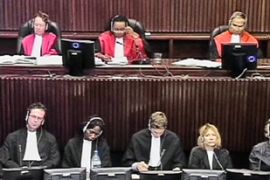
The UN-backed judges acquitted Konewa
and Fofana of crimes against humanity [AP]
A UN-backed war crimes court in Sierra Leone has convicted two men of committing atrocities while they led a force allied to the government during the country's 10-year civil war.

Allieu Kondewa and Moinina Fofana of the Civil Defence Forces (CDF), however, were acquitted of the separate charge of committing crimes against humanity on Thursday.
The CDF was a paramilitary group which recruited traditional Kamajor hunters to fight anti-government forces during the 1991-2001 conflict.

The two had pleaded not guilty to all eight charges of war crimes and crimes against humanity levelled against them.
They were both acquitted on charges of murder and other inhumane acts, while Fofana, as the war director and second in command of the CDF ranks, was cleared of conscripting child soldiers.

Along with the government army, the CDF fought the Revolutionary United Front (RUF) in a war that claimed, according to UN estimates, about 120,000 lives.

The international tribunal in Freetown, Sierra Leone's capital, was created in January 2002 by a treaty between the Sierra Leone government and the UN.

The court is charged with prosecuting those responsible for atrocities committed during the war.

Conflict

The fighting in Sierra Leone began in 1991 when Foday Sankohm, an ex-army corporal, and his RUF group took up arms against Joseph Momo, president at the time.

RUF fighters were popular at first, but they earned a reputation for murder, rape, mutilation and recruiting child soldiers.

The conflict was funded partly by diamonds mined in southern and eastern Sierra Leone, which, once-publicised, led to a global campaign against so-called "blood diamonds" mined in conflict zones.

In 1997, the Armed Forces Revolutionary Council (AFRC), a group of army officers allied to the RUF fighters, overthrew Ahmad Tejan Kabbah, the elected president, but a Nigerian-led regional force reinstated him within a year.

A truce was agreed in 1999 after heavy fighting in Freetown, but it fell apart in 2000.

Disarmament was completed with UN assistance in 2002 and the conflict was formally declared over.

Kabbah was re-elected in May 2002 and the RUF, standing as a political party, won little support in the ballot. Sankoh died in prison in 2003 while facing a war crimes indictment.

The toll from the war is estimated at 50,000 in a country that has a population of about six million people, and was placed second from bottom in the 2006 UN Human Development Index.

Source:
Agencies
Topics in this article
Country
Organisation
Featured on Al Jazeera
Al Jazeera's exclusive publishing of a key Guantanamo prison military document lays bare the brutality of force-feeding.
Former military official says poverty and anger in indigenous communities mean conditions for an "insurgency" are ripe.
A four-part series that gives a rare insight into the country on the move, with history in tow.
Series on the Palestinian 'catastrophe' of 1948 that led to dispossession and conflict that still endures.
Featured
Lebanon-based militia is assisting villagers caught up in the conflict.
Two years since the start of the uprising, rebels and Assad's forces remain locked in conflict.
Ancient ruins of Mes Aynak threatened by planned Chinese mining project.
A four-part series that gives a rare insight into the country on the move, with history in tow.
Extensive coverage of war crimes tribunals and controversial calls for blasphemy laws.
join our mailing list