Lebanon still struggling to rebuild
Country’s political deadlock is affecting reconstruction after the war.
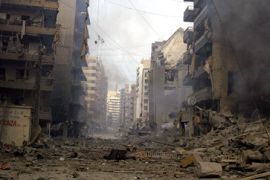
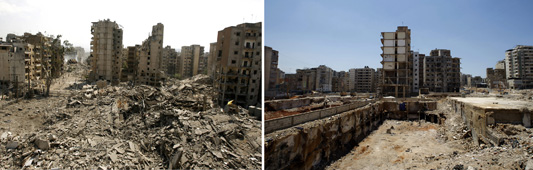 |
| Many suburbs of Beirut still have lot of rebuilding to be done [AFP] |
The Lebanese government is continuing reconstruction in the aftermath of the 34-day war between Israel and Hezbollah last summer that killed over 1,000 Lebanese, mostly civilians.
| Special report | ||||
|

When hostilities ended, the Swedish government hosted a conference in Stockholm, raising $900 million in humanitarian assistance.
However, many residents are not receiving financial aid to assist in post-war recovery.
The reconstruction effort aims to bring about wider changes to improve the Lebanese economy but the opposition views it as politically motivated.
Jihad Azour, the finance minister told Al Jazeera that these changes are needed.
“The objective of the reform programme is to stimulate growth, create employment, reduce poverty, and maintain social and political stability,” he said
Accumulating problems
Salwa, a restaurant owner in Beirut said she is not feeling this assistance is trickling through.
“No one is helping me. Beirut used to be a good place for business. Now it’s empty, and the government is not helping business owners,” she said.
| Q&A |
This led to strikes and protests highlighting the increased financial pressure on its residents.
Rafiq al-Hariri undertook a plan to rebuild Lebanon after the 1975-1990 civil war.
During his first term as prime minister Lebanon owed $17 billion in debt, and used 89 per cent of government money to repay it.
After last year’s war, the debt figure has reached $41 billion – one of the highest levels in the world, in relation to the country’s population.
Divided opinion
Ghassan Ghosn, a trade union official, told Al Jazeera that low income earners will not be able to deal with new taxes that come with the reform package.
“We need greater focus on social changes here, not an increase in taxes for people who can’t afford it,” he said.
Louis Hobeika, professor of economics and finance at Notre Dame University in Beirut, says the current instability renders any plans for substantial change futile.
“We are still in the cloud of war. How can change happen in a country when we are still in conflict?” he says.
Hobeika says that greater transparency is needed from the government in order go forward with rebuilding the country.
“There is government inefficiency, and the public are not properly informed. If they are not informed, they will be angry.”
|
|
Outsourcing the south
In the south of Beirut, however, the money is pouring in.
About 500,000 residents lost their homes in the Israeli bombings but one month after the war, Hezbollah contributed millions of dollars and pledged that they would rebuild the south of the country on their own.
Jihad Azour said, however, that the government is not in competition to gain popularity amongst its citizens.
“We have been the biggest contributor to the state and we will not compete with other political entities,” he said.
Meanwhile, as residents in the south continue to rely on Hezbollah for assistance, the Siniora government has called for “dialogue and reconciliation”, trying to unify opposing parties.
Despite everything, Mohammed Maatouk, a taxi driver, is hopeful.
“I think things will get better. We Lebanese still manage somehow to continue on with our lives”.