Danish text clouds Copenhagen work
Climate summit delegates try to get back to work but leaked text continues to dominate.

Published On 10 Dec 2009
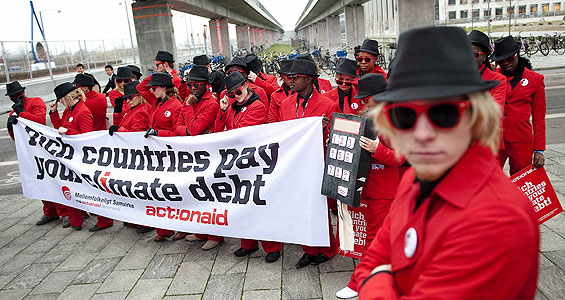 |
| Activist groups squarely place the blame for the climate crisis on rich nations [Reuters] |
They were a striking sight in the dull, early morning.
In their red hats and suits, their dark shirts and glasses they caught the mood of the moment, chanting: “We are watching you. You know what to do, pay the climate debt.”
Keep reading
list of 4 itemsTurtles swimming to extinction in Malaysia as male hatchlings feel heat
Could shipping containers be the answer to Ghana’s housing crisis?
Thousands protest against over-tourism in Spain’s Canary Islands
This was a reminder how many activist here blame the developed world for the climate crisis, for their carbon emissions as industrialisation built their fortunes while stealing their futures.
| in depth |
|
|

There had been a feeling of momentum, a sense that all 192 countries were moving in the one direction, heading for a deal.
But on Day 3, that had been replaced with an air of suspicion.
‘Danish text’
The problem, the so-called “Danish text”, a set of proposals drawn up by the Danish, the British and the Americans which, among others, proposed radical ideas which were instantly rejected by many of the world’s poorer countries.
The basis of the document proposed that both industrialised and emerging countries cut carbon emissions to limit global warming and that the UN is sidelined in future talks about climate change.
The conference tried to get back to work, but in the small meeting halls and coffee shops that dot this huge sprawling venue, it was the topic that continued to dominate.
Near one I found Kumi Naidoo, the new charismatic head of the environmental group Greenpeace.
He told me the text showed that the rich, powerful countries were reluctant to hand over power in the negotiations.
“The Danish text is dead in the water. Now we have to go back to the hard work that’s been done since the Bali summit two years ago.
“Let’s not ignore what the negotiators have done but we should keep our eye on the prize which is to deliver to our children and grandchildren a fair, ambitious and binding treaty which secures their future”.
Work to be done
One of the groups most at risk from the continuing rise in global temperatures is the Association of Small Island states.
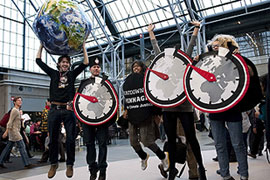 |
| Most discussions at the Copenhagen climate talks are behind closed doors [Reuters] |
A two degree Celsius rise in temperatures, the limit the world is aiming for, still means for them higher seas, a change to the way they live, a threat to life itself.
Every morning they meet to discuss their plan for the day.
Every night they gather to discuss what they’ve achieved, and the tactics to use the next day.
Their chairperson is the impressive Dessima Williams, Grenada’s ambassador to the United Nations.
She understands why people are upset by the leaked document, but believes people should now get back to work.
In between her never ending round of meetings in Copenhagen, she told me: ‘”We don’t see this as something which will disrupt the meeting. In fact, as far as I know, this paper was floated and withdrawn some time ago, so it hasn’t disturbed us at all.”
This smart and savvy diplomat has been at enough of these gatherings to know how things work.
Most of the discussions here, the most important climate talks in history, are held behind closed doors.
There’s no access for the media, none for environmentalists who may have a case to present.
Somehow, in all these discussions, over the course of the next few days, various drafts will be floated.
Some will anger the rich nations; some will send the developing countries into a tirade.
But in the flurry of proposals and ideas, one will form the basis of a deal, if there is one.
The world leaders will arrive in Copenhagen next week to sign a deal which they will claim will change the world.
It appears a few attitudes may have to change first.
Source: Al Jazeera