Greenspan defends role in recession
Former US Federal Reserve chief denies that his policies encouraged risky lending.
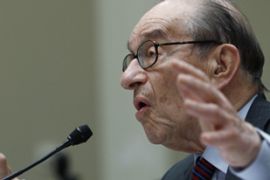
“Managers of financial institutions, along with regulators, including but not limited to the Federal Reserve, failed to comprehend the underlying size, length and potential impact” of market risks that contributed to the crisis.
Greenspan said the crisis reinforced important messages about what “supervision and examination” can and cannot do.
“History tells us they cannot identify the timing of a crisis, or anticipate exactly where it will be located or how large the losses and spillovers will be,” he said.
‘Abusive’ subprime loans
Greenspan’s critics had accused him of leaving interest rates too low in the early part of the decade, spurring an unsustainable housing boom which went largely unregulated.
He again faced heated exchanges during Wednesday’s hearing, as Phil Angelides, the commission chair, accused him of failing to prevent “abusive and deceptive” subprime home loans from causing the collapse of the housing market.
“You could’ve, you should’ve, and you didn’t,” Angelides said.
| In depth |
 The best of Al Jazeera’s reports on the recession |
Al Jazeera’s Rosiland Jordan, reporting from Washington, said the congressional commission is investigating whether Greenspan used his ability to issue regulations to try to clamp down on the issuance of subprime mortages.
“Basically, giving mortgages to people who didn’t earn enough money to pay the mortgages back,” she said.
“There’s a lot of back and forth going on right now about whether or not Greenspan saw the problem, did enough to regulate the problem, or at least write the rules so other federal agencies could clamp down on the banks who were making billions of bad loans.”
But Greenspan denied in his testimony on Wednesday that the policies of low interest rates and loose regulation encouraged lenders and borrowers to take greater risks.
“The house price bubble, the most prominent global bubble in generations, was engendered by lower interest rates, but… it was long-term mortgage rates that galvanised prices, not the overnight rates of central banks,” he said.