[QODLink]
Business
Gulf states agree on monetary union
Gulf Arab states will maintain their 2010 deadline for a single currency.
Last Modified: 31 Dec 2008 04:59 GMT
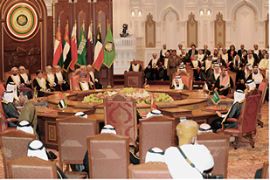
The single currency plan has been derailed for years but the GCC agreed to keep the 2010 deadline [EPA] 

Gulf Arab states will maintain their 2010 deadline for a single currency, the secretary-general of the Gulf Cooperation Council (GCC) has said.

Leaders of GCC countries (Saudi Arabia, the United Arab Emirates, Kuwait, Qatar, Oman and Bahrain) approved a final draft of an accord on a monetary union agreement in their annual summit in Muscat, the capital of Oman, on Tuesday.

The agreement would pave the way for a single currency, which all GCC states but Oman are working towards launching.

"I think it is within the time which has been allocated .. 2010," Abdul-Rahman al-Attiyah said in response to a question about a date for a common currency.

"Let's wait until, God willing, we agree on the location [of the common central bank] and the other details," he said.

The five GCC states "adopted the monetary union accord, which includes the legal and organisational framework," a statement issued at the end of the Muscat summit said.

"It [the council] also adopted a system governing the monetary council," the statement said.

Inability to decide on the location of the regional central bank, which will be independent from the governments of member countries, has been an obstacle to the plan for years.

The United Arab Emirates, Qatar, Bahrain and Saudi Arabia have all expressed interest to host the bank.

The GCC nations are seeking better coordination on economic policies as the oil price has dropped and the global financial crisis has hit the region's economic boom.

Source:
Agencies
Topics in this article
Country
Organisation
Featured on Al Jazeera
Al Jazeera's exclusive publishing of a key Guantanamo prison military document lays bare the brutality of force-feeding.
Former military official says poverty and anger in indigenous communities mean conditions for an "insurgency" are ripe.
A four-part series that gives a rare insight into the country on the move, with history in tow.
Series on the Palestinian 'catastrophe' of 1948 that led to dispossession and conflict that still endures.
Featured
Lebanon-based militia is assisting villagers caught up in the conflict.
Two years since the start of the uprising, rebels and Assad's forces remain locked in conflict.
Ancient ruins of Mes Aynak threatened by planned Chinese mining project.
A four-part series that gives a rare insight into the country on the move, with history in tow.
Extensive coverage of war crimes tribunals and controversial calls for blasphemy laws.
join our mailing list